ArtsFunded guide
How to Write a Strong Arts Council England Project Grant
Step-by-step guide to structuring Need, Outcomes, Audience, Activities, Budget and Evaluation for Arts Council England Project Grants.
Published · Last updated · By ArtsFunded editorial team
TL;DR
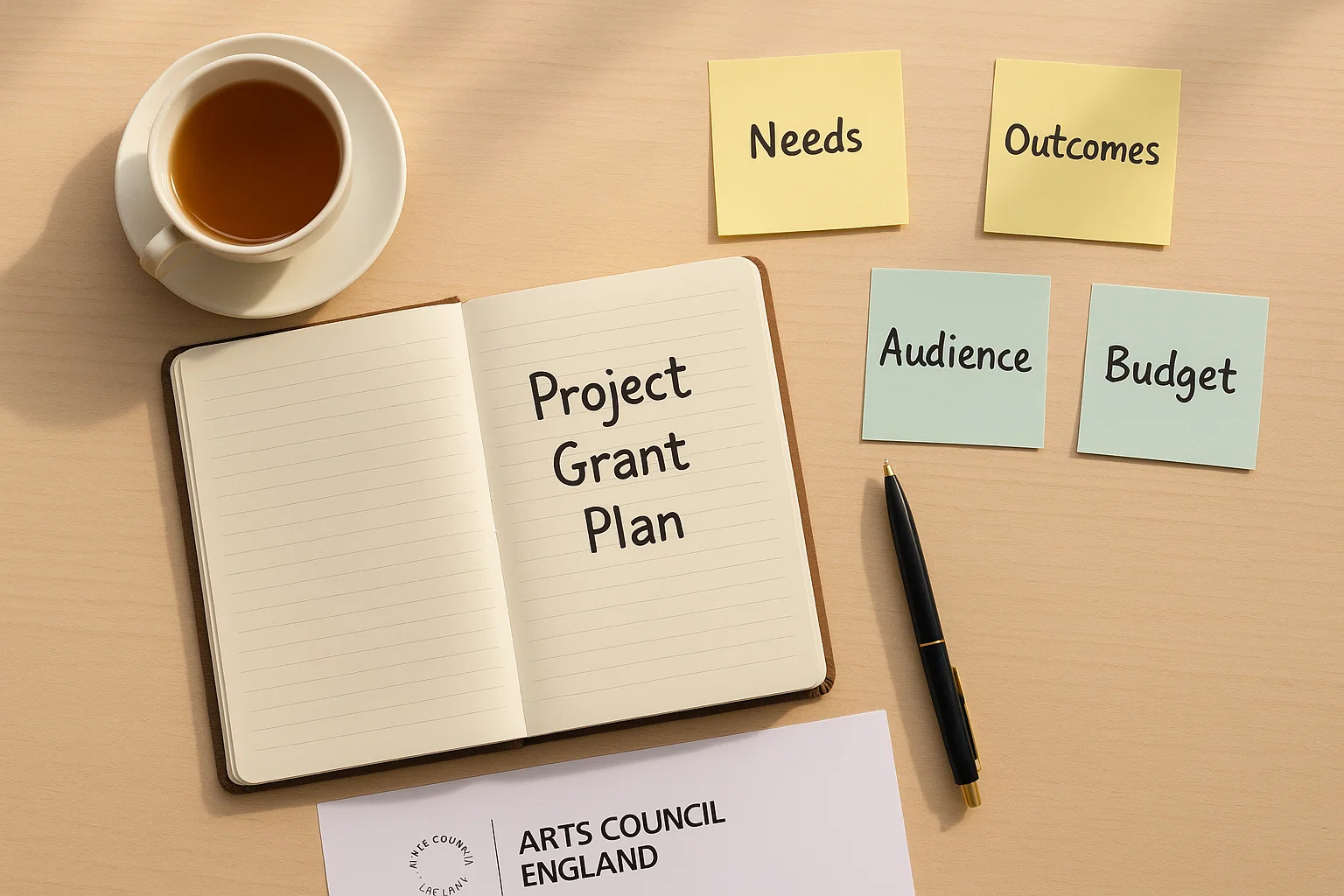
- Follow the flow Need → Outcomes → Audience → Activities → Budget → Evaluation.
- Write plainly, link every activity to a measurable outcome, and cost access plus evaluation properly.
- Watch the five minute walkthrough to see questionnaires, reviews, and drafts in one pass.
- Need extra help separating Need and Outcomes? Jump to this focused companion guide.
ACE’s National Lottery Project Grants form can feel repetitive. A consistent, reviewer-friendly structure keeps the core message clear. Use this guide as a checklist while you draft, revise, or review your answers.
What is Arts Council England?
Arts Council England (ACE) funds and supports arts, museums, and libraries across England. Its National Lottery Project Grants (NLPG) programme backs artists, organisations, and community groups to deliver creative work with public benefit. Whether you are a theatre company, visual artist, or community collective, Project Grants can fund research, creation, touring, or engagement activity that leads to strong artistic outcomes.
Browse more ACE guides → ACE Hub
---
What funders expect
- Clear public benefit: who benefits, how, and why it matters now.
- Credible delivery plan: activities, roles, partners, and timings that add up.
- Realistic budget: fair day rates, access, evaluation, and sensible contingency.
- Inclusion & access: BSL, captions, relaxed sessions, travel bursaries, pricing, etc.
- Evidence of demand: quotes, waiting lists, partner letters, past turnout, or local data.
- Risk management: name the risks and show the mitigation.
- Evaluation & learning: light-touch ways to test success and share what you learn.
---
Common mistakes (and how to fix them)
- Talking about your funding gap instead of public need.
Switch the focus to the community or audience problem. Add two or three proof points.
- Writing vague outcomes (“raise awareness”, “build community”).
Make the change specific, measurable, and time-bound. Example: “Reach 500 residents (60% new to the venue); 80% report feeling more confident to create.”
- Activities that don’t feed any outcome.
For every activity, state the outcome it delivers. If it can’t be linked, cut or rescope it.
- Under-costing access and evaluation.
Ring-fence BSL, captioning, relaxed sessions, travel support, evaluation time, and genuine overheads.
- Heavy jargon.
Write in plain English, active voice, short sentences. Assume smart but busy reviewers.
---
A simple answer framework you can copy
- Need - lead with public benefit.
In 3 - 5 sentences explain the gap or opportunity for your community. Add two or three proof points (quotes, waiting lists, partner data). Prompt: Who benefits, how do you know, and what happens if you do nothing this year?
- Outcomes - what will change.
List 3 - 5 short, measurable outcomes. Put the strongest first. Example: “200 young people attend six workshops; 70% report improved wellbeing (short survey).”
- Audience - who, where, how you’ll reach them.
Summarise primary audience, targeted groups, partners, channels, and access considerations (pricing, transport, language, disability access). Prompt: How will someone hear about it, get there, and feel welcome?
- Activities & timeline - what happens when.
List key milestones with leads and the outcome each activity supports. Example: “Jan - Feb: co-design sessions (Lead: X) → supports Outcomes 1 - 2.”
- Budget & value for money - include access.
Summarise totals, day rates, access, evaluation, and contingency. Name any confirmed or pending match. Prompt: Would a trustee believe this is deliverable at this price?
- Evaluation & learning.
Pick two or three light-touch methods that match your outcomes: headcounts, short surveys, interviews, quick debrief logs. Explain how you’ll use the learning.
- Risk & safeguarding.
Name 3 - 5 material risks, the mitigation, and who owns it. Be brief but credible.
- Organisation & partners.
One paragraph on your track record and why these partners are right. State responsibilities clearly.
---
Mini example you can adapt
Need - In X ward only 12% of teens access arts weekly; the youth centre has long waiting lists. Outcomes - Engage 200 teens; 60% report better confidence; 10 young leaders complete training. Audience - Ages 13 - 18 in X and Y; reach via schools, youth centre, Insta/TikTok; free travel for those on benefits. Activities - Six co-created workshops (Mar - Apr); pop-up showcase (May). Budget - £27,800 including artist day rates, venue, materials, BSL/captions (£2,400), evaluation (£1,200), 5% contingency. Evaluation - Headcounts, four-question survey, eight mini-interviews, staff debrief. Risks - Low sign-ups → partner referral; staff illness → associate pool; weather → indoor backup. Partners - X Youth Centre (recruitment & space); Y College (leaders); Z CIC (access support).
---
Next steps
- Draft the Need and Outcomes sections first; let them drive every activity and budget line.
- Revisit the Need vs Outcomes companion post if those sections still feel unclear.
- Run a reviewer pass (inside ArtsFunded or with your team) before you generate the final answers.
Need a head start? ArtsFunded drafts ACE-ready answers, pulls research, and highlights gaps in minutes. Explore pricing →
---